How to know if you are a LASIK candidate before you pay for surgery
A free LASIK pre-consultation won't tell you if you qualify. It takes five specific tests. Here's what each one checks, and what disqualifies 1 in 5 patients.
In short: The “free pre-consultation” isn’t what most patients think it is. Knowing whether you’re a LASIK candidate takes five specific tests that many clinics skip. In 15-20% of cases, those tests say no. It’s worth finding out before surgery, not after.
You’re about to read things no LASIK ad will tell you: why your candidacy for laser surgery depends on five tests, not a free pre-consultation; what happens during an honest evaluation when the factor that disqualifies 15-20% of patients shows up; and why the phrase “every eye qualifies” is a promise no serious ophthalmologist will make. If you live near León and you’re considering leaving your glasses behind, this changes how you choose a clinic.
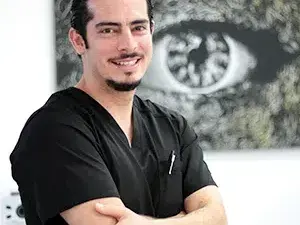
Dr. Emmanuel Bolaños Betancourt: ophthalmic surgeon with subspecialty training in cornea, refractive surgery, and cataract microsurgery. He sees patients at Hospital Aranda de la Parra Puerto Interior (20 minutes from León) and at Oftalmo-Visión Clínica Oftalmológica in downtown Silao. Board certified by the Consejo Mexicano de Oftalmología since 2013. Over 15 years in clinical practice. 292 combined Google reviews with a 4.9 average.
What the free pre-consultation doesn’t tell you
Almost every laser surgery clinic offers a free “candidacy consultation.” That’s marketing, not medicine. At that appointment, they typically measure your prescription, run a quick refraction, and tell you “yes, you’re a candidate.” Sometimes that’s true. Often you don’t find out otherwise until months later, when something goes wrong.
The problem isn’t the free consultation itself. The problem is what that consultation doesn’t include. A real LASIK evaluation requires five tests that can’t be done in 20 minutes, or with the basic equipment any optical shop has on hand.
That free pre-consultation is built to sell you an idea, not to evaluate you. What actually evaluates you is a different process, built around five specific tests.
The five tests that separate a serious surgeon from a fast one
These five tests are the non-negotiable minimum. If a clinic offers you surgery without them, something is missing, and what’s missing is exactly what disqualifies candidates.
- Corneal topography: maps the shape of your cornea’s surface. This is where irregularities that would make any laser cut unsafe show up.
- Corneal tomography: evaluates the internal structure and posterior elevation of the cornea. It detects forme fruste keratoconus (the earliest stage of keratoconus), which no other test can see.
- Pachymetry: measures your cornea’s thickness at different points. Without enough corneal thickness, LASIK isn’t safe.
- Aberrometry: detects complex optical aberrations that can cause halos and glare at night after surgery.
- Slit lamp exam: examines the cornea, lens, and other structures in detail.
There’s a sixth factor that isn’t a test but carries just as much weight: your complete medical history. Poorly controlled diabetes, autoimmune disease, pregnancy or breastfeeding, abnormal healing, glaucoma, prior severe dry eye. All of these are contraindications that no single test detects, but that change the decision.
When these five tests are done properly, there are three possible answers: yes, not yet, and no. The most uncomfortable answer is also the most honest one.
When the tests say LASIK isn’t for you
In 15-20% of the patients I evaluate, the tests reveal something that rules out LASIK. The most common reasons are:
- Forme fruste keratoconus: a cornea with early signs of progression. LASIK would weaken a cornea that is already compromised.
- Cornea that isn’t thick enough: the flap cut plus the ablation would leave less residual tissue than is safe.
- Unstable prescription: your prescription changed in the last 1-2 years. Operating now means falling short again in six months.
- Severe dry eye: LASIK makes dry eye worse. In patients who already have it, surgery worsens their symptoms.
When a case isn’t a candidate for LASIK, there are alternatives: PRK (when the cornea is thin but stable), ICL (a lens implanted without touching the cornea), or an intraocular lens in older patients where presbyopia is already setting in. The conversation changes, but it doesn’t end there.
If the tests say yes, there’s still an important decision left. Between LASIK and PRK there are differences almost no one explains well.
LASIK versus PRK: the difference that changes your outcome
Both techniques use excimer laser to reshape the cornea. The difference is how the surgeon accesses the layer being treated:
| LASIK | PRK
---|---|---
Technique | A flap is created in the cornea | The surface is treated directly
Visual recovery | 24-48 hours | 3-5 days, full stabilization in 2-4 weeks
Discomfort afterward | Minimal | More in the first few days
Ideal for | Corneas with adequate thickness | Thin, irregular, or dry corneas
Back to normal | Next day | 1-2 weeks
If your cornea is a good candidate for both, LASIK usually wins on faster recovery. If there’s any sign of corneal fragility, PRK is the safer choice even though recovery is slower.
What surgery day looks like, minute by minute
Once your candidacy is confirmed, surgery is outpatient and quick:
- Anesthetic drops, no needles
- Actual laser time: 30-60 seconds per eye
- Total time in the operating room: 15-20 minutes
- You walk out the same day
- No driving, dark glasses for bright light
- You’ll need someone to drive you home
Follow-up visits happen at 24 hours, one week, and one month. Full stabilization of your result takes about three months.
What coming from León looks like if you live far away
I perform LASIK, and PRK too, in León, at Hospital Aranda de la Parra in León (downtown branch, M. Hidalgo 329), with the TENEO laser. The evaluation can be at my office in Hospital Aranda de la Parra Puerto Interior, on Boulevard Mineral de Cata in Silao, about 25 minutes from downtown León on the road to Bajío International Airport. The hospital has parking, and access to the office is direct from the first-floor entrance.
For a typical LASIK surgery you’ll need two visits: one for a complete evaluation with all five tests, and another for the surgery itself, with condensed follow-up in the days after. I coordinate both dates so you don’t travel more times than necessary.
You’ve now seen what a serious surgeon evaluates, what happens if the tests say no, the difference between LASIK and PRK, what surgery day looks like, and what coming from León involves. What’s left is the part people ask about most. Price is never the first variable, but there are three things you need to understand before comparing numbers.
About the price
LASIK costs MXN 25,000 for both eyes (price as of October 2026). That price applies once the tests confirm you’re a LASIK candidate. If your cornea calls for PRK or another technique, I’ll give you that cost with your test results, before you sign anything.
If you decide not to have surgery, that’s fine. You only pay for the evaluation.
Last updated: · Reviewed by Dr. Emmanuel Bolaños, ophthalmic surgeon (Mexican Board of Ophthalmology, member 3045).
What my patients say
292 Google reviews across my two offices, averaging 4.9. Here are a few, translated from Spanish.
He performed my surgery to correct nearsightedness and astigmatism. From the first evaluation he explained the procedure with great clarity and patience, which gave me complete confidence. The surgery was quick and painless, and the follow-up has been impeccable. Today I enjoy excellent vision!
The doctor is a very professional specialist, attentive and committed to his patients. He is always ready to answer any question and supports you throughout the whole process, from surgery to recovery.
He performed pterygium surgery with a conjunctival autograft, and I am very grateful for his professionalism, clarity and follow-up throughout my recovery. He always kept an eye on my progress and answered my questions kindly.
See reviews for Hospital Aranda de la Parra · Puerto Interior (5.0 · 113) → · See reviews for Oftalmo-Visión Clínica Oftalmológica (4.8 · 179) →
Want me to look at your case?
Send me a WhatsApp with the reason for your visit. I will tell you whether an evaluation makes sense and which of my two offices to come to, before you make the trip. The whole visit can be in English.